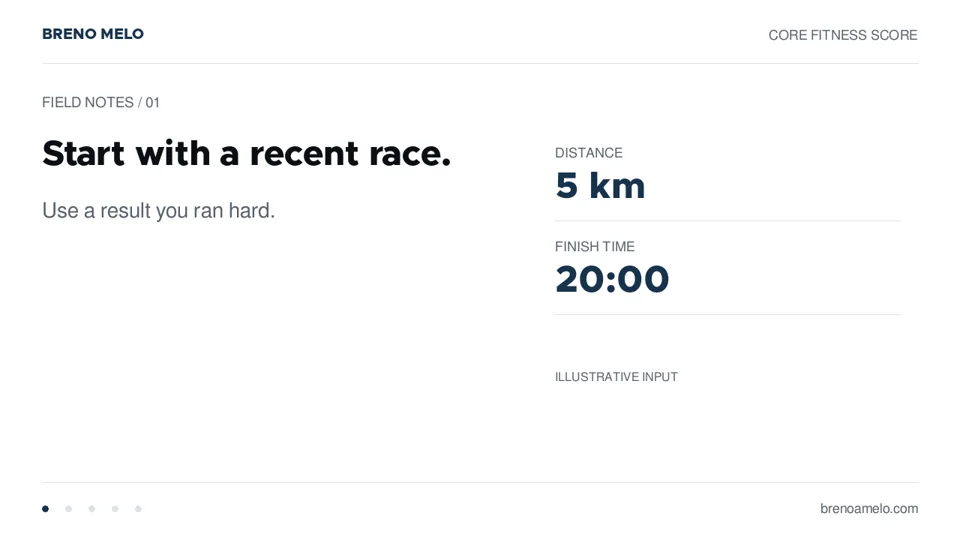
Start with a race you can describe honestly
Use a recent result and enter the distance and time accurately. Add context before treating the output as a training target: was the course measured, was the effort representative, and did conditions or terrain materially change the result? A precise score cannot repair an uncertain input.
Read the equivalent times as a model
A 20:00 5K produces a CORE Fitness Score of about 49.8 in this implementation, with model equivalents near 41:28 for 10K and 3:11:17 for a marathon. The marathon number assumes more than speed over 5K. Your endurance preparation, fueling and the course decide whether it is a sensible race goal.
Which pace should you use tomorrow?
Choose the session first, then read the relevant pace range. Easy running, sustained work and short repetitions serve different purposes. A score does not tell you how many hard sessions belong in your week or how much recovery you need. That is the plan-design decision around the numbers.
Update when the evidence changes
Save the source result and its date with the pace chart. Use a newer representative performance when you have one, rather than adjusting the score upward after every good training day. CORE Fitness Score credits the Daniels–Gilbert equations; it is not a measured laboratory VO2max or an affiliation with V.O2.
Bring the result and the context
Enter a recent race, then save the distance, time, conditions and date with your pace chart. Select the range for the session you are actually doing. If the result came from an unusually hot race or a difficult course, discuss that context before substituting a faster hypothetical result.
Common questions
Which race should I use?
Choose a recent representative result and the actual measured distance. A downhill, hot or interrupted race needs context rather than a hidden correction.
How do the training bands differ?
The tool shows Easy, Marathon, Threshold, Interval and Repetition ranges. They organize intensity; the repetition duration and recovery still determine the workout.
Why is the marathon equivalent not my race plan?
Equivalent aerobic performance does not establish marathon durability or fueling tolerance. Check preparation before adopting the modeled time.
What does a score change mean?
Compare dated races, including distance and conditions. A trend made from very different events is evidence to review, not automatic proof of a precise fitness change.
PUT IT INTO PRACTICE
Take the next step.
Sources & author
The research and methods behind this article: