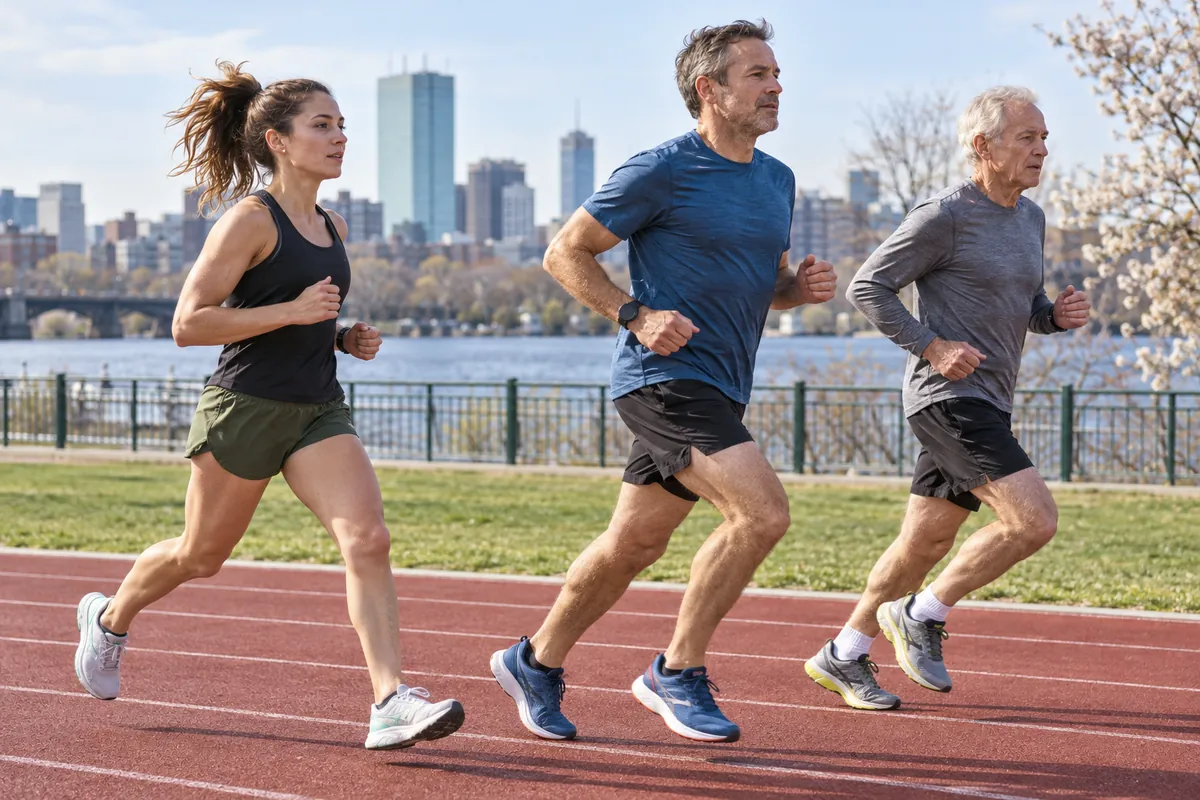
Boston Marathon Qualifying Times by Age (2026 & 2027 Standards + Real Cut-Off)
Full 2026 & 2027 Boston Marathon qualifying times by age and gender, the per-mile pace to hit each standard, and the realistic BQ cut-off you actually need to beat.

Short answer: for the 2026 and 2027 Boston Marathons, men aged 18–34 need 2:55:00 and women and non-binary runners aged 18–34 need 3:25:00. Standards ease every five years up to 80+. But the published time rarely earns a bib: the 2026 race accepted only runners who beat it by 4:34, so train for a 5:00 cushion. Full chart by age group below, verified 27 July 2026 against the BAA.
| Age on race day | Men | Women / non-binary | Men's pace /mi | Realistic target (men) |
|---|---|---|---|---|
| 18–34 | 2:55:00 | 3:25:00 | 6:40 | 2:50:00 |
| 35–39 | 3:00:00 | 3:30:00 | 6:52 | 2:55:00 |
| 40–44 | 3:05:00 | 3:35:00 | 7:03 | 3:00:00 |
| 45–49 | 3:15:00 | 3:45:00 | 7:26 | 3:10:00 |
| 50–54 | 3:20:00 | 3:50:00 | 7:38 | 3:15:00 |
| 55–59 | 3:30:00 | 4:00:00 | 8:01 | 3:25:00 |
| 60–64 | 3:50:00 | 4:20:00 | 8:46 | 3:45:00 |
| 65–69 | 4:05:00 | 4:35:00 | 9:21 | 4:00:00 |
| 70–74 | 4:20:00 | 4:50:00 | 9:55 | 4:15:00 |
| 75–79 | 4:35:00 | 5:05:00 | 10:29 | 4:30:00 |
| 80+ | 4:50:00 | 5:20:00 | 11:04 | 4:45:00 |
Standards are based on your age on race day, and the BAA applies the women's standards to the non-binary division. The "realistic target" column subtracts a 5:00 cushion, because the published standard has not been enough to earn a bib in most of the last ten cycles — the 2026 race accepted only runners 4:34 under. Verified 27 July 2026 against https://www.baa.org/races/boston-marathon/qualify/.
The Boston Marathon qualifying standards look simple on paper. You run faster than your age-group time, you submit your application, you toe the line on Patriots' Day. In reality, the published standard is the entry fee — not the actual cut-off. Every year, more qualifiers apply than there are bibs, and the Boston Athletic Association tightens the field by accepting only those who beat the standard by a certain margin. That margin is the real BQ. This guide gives you both: the published standards by age and gender, and the realistic cushion you should plan for if you actually want to run Boston.
Quick answer: the 2026 and 2027 standards in one line
Qualifying pace by age group
The standard is a finish time, but you race a pace. This is the same set of standards expressed as the pace you have to hold for all 26.2 miles — and the pace that clears the 5:00 cushion. If the cushion pace is more than about 20 seconds per mile faster than your current marathon pace, you are looking at a full training cycle, not a tune-up.
| Age group | Men /mi | Men /km | Women & non-binary /mi | Women & non-binary /km |
|---|---|---|---|---|
| 18–34 | 6:40 | 4:09 | 7:49 | 4:52 |
| 35–39 | 6:52 | 4:16 | 8:01 | 4:59 |
| 40–44 | 7:03 | 4:23 | 8:12 | 5:06 |
| 45–49 | 7:26 | 4:37 | 8:35 | 5:20 |
| 50–54 | 7:38 | 4:44 | 8:46 | 5:27 |
| 55–59 | 8:01 | 4:59 | 9:09 | 5:41 |
| 60–64 | 8:46 | 5:27 | 9:55 | 6:10 |
| 65–69 | 9:21 | 5:48 | 10:29 | 6:31 |
| 70–74 | 9:55 | 6:10 | 11:04 | 6:52 |
| 75–79 | 10:29 | 6:31 | 11:38 | 7:14 |
| 80+ | 11:04 | 6:52 | 12:12 | 7:35 |
The real cut-off: what you actually need to beat
The BAA applies a registration cut-off above and beyond the published standard whenever more qualifiers apply than there are bibs. Here is the actual record: 2019 4:52 under, 2020 1:39 under, 2021 7:47 under, 2022 no cutoff, 2023 no cutoff, 2024 5:29 under, 2025 6:51 under, 2026 4:34 under. The 2026 race required 4:34; the largest on record here was 7:47.
What cut-off should you expect for the 2027 race?
Nobody knows the 2027 number until the BAA closes the September registration window and publishes it about a week later — anyone quoting an exact figure now is guessing. What the record supports is a range. The last five accepted cut-offs average 3:23 under the standard, the most recent was 4:34, and the largest ever here was 7:47. Because the 2026 and 2027 races share the same tightened standards, the qualified applicant pool is smaller than it was before the change — but demand has consistently refilled it within two cycles. Planning for 5:00 keeps you inside every cut-off of the last five years except the 2021 outlier.
- Safe: 7:47+ under the standard — accepted in every year on record
- Realistic target: 5:00 under — clears the recent trend
- Risky: under 2:00 of margin — rejected in most of the last ten cycles
- Registration opens mid-September; the cut-off is announced roughly a week after it closes
Every Boston cut-off since 2019
This is the year-by-year record of how far under the published standard you actually had to be to get accepted. Read it as a trend, not a table of trivia: outside the two pandemic-affected cycles (2022 and 2023, when every qualifier who applied was accepted), the cut-off has never dropped below 1:39 under.
| Race year | Cut-off under the standard | What it meant |
|---|---|---|
| 2019 | 4:52 | A 5-minute cushion would have cleared it |
| 2020 | 1:39 | A 5-minute cushion would have cleared it |
| 2021 | 7:47 | A 5-minute cushion would not have been enough |
| 2022 | None | Every qualified applicant was accepted (pandemic-reduced pool) |
| 2023 | None | Every qualified applicant was accepted (pandemic-reduced pool) |
| 2024 | 5:29 | A 5-minute cushion would not have been enough |
| 2025 | 6:51 | A 5-minute cushion would not have been enough |
| 2026 | 4:34 | A 5-minute cushion would have cleared it |
What the trend actually tells you
- The eight-year average cut-off is 3:54 under; the last five years average 3:23 under
- The 2026 cut-off (4:34) came down from 6:51 in 2025 — the first cycle run under the tightened standards, which shrank the qualified pool
- Standards did not change for 2026 or 2027, so the pool has a full extra cycle to refill — expect the cut-off to hold or drift back up, not collapse
- Every cycle in the last decade with a normal applicant pool has produced a cut-off; plan as if there will be one
How the registration window works
- 01Your qualifying race must be a certified marathon run inside the BAA's qualifying window (it opens roughly 18 months before race day)
- 02Registration opens in mid-September and stays open for about five days — everyone applies in the same window; there is no first-come advantage
- 03The BAA then accepts applicants in order of how far under their standard they ran, fastest margins first, until the field is full
- 04The cut-off is announced roughly a week after registration closes, and acceptances go out at the same time
- 05Your margin is what matters — not your finish time. A 3:20:00 at 52 years old carries the same weight as a 2:55:00 at 30
How to train for a real BQ
Most runners who chase Boston train for the published standard and miss by 4 minutes. The smarter approach is to train for the cushion. Build a plan that targets a goal time 5 minutes faster than the published standard for your age group. That's the time you'll need to actually get a bib.
Three pillars of a BQ build
- 01Aerobic volume — most BQ runners under-do volume. You want 50–80 km per week for 12+ weeks, depending on background
- 02Marathon-pace work — the back half of long runs at goal BQ pace is the workout that wins races
- 03Threshold capacity — one weekly tempo session sharpens your sustainable speed and protects your goal pace from feeling hard early
Common reasons people miss the cut-off
- Training for the published standard, not the realistic cut-off
- Going out 5–8 seconds per km too fast in the first 5K — bleeds energy that costs minutes at km 35
- Choosing a hilly or unpredictable course when a flat, fast certified race exists at the same time of year
- Skipping the heat-acclimation work for a spring marathon
- Not building enough cushion in long-run pace work — your goal pace should feel sustainable, not survivable, at km 30 of your long runs
Boston isn't a finish-line lottery. It's a margin problem. The athletes who get bibs train for the cushion, not the standard.
— Breno Melo
Which races give you the best shot?
Flat, certified, weather-predictable courses with quality pace groups are your best friends. CIM (Sacramento), Chicago, Berlin, Erie, Indianapolis Monumental, and Mountains 2 Beach all qualify well above their share. Avoid choosing a destination race for your BQ attempt unless you've already qualified once and want a victory lap.
If you want a plan engineered specifically to land you under the real cut-off — not just the published standard — that's what I do with the Boston-focused athletes I coach. Book a free call and we'll talk timeline.
Questions athletes ask about this
- What is the Boston Marathon qualifying time for 2026?
- For the 2026 Boston Marathon, men 18–34 must run 2:55:00 or faster and women and non-binary athletes 18–34 must run 3:25:00 or faster. Standards get progressively easier with age. These standards are 5 minutes tighter across every age group under 60 than the previous set, following the BAA announcement of 16 September 2024.
- What is the Boston Marathon qualifying time for 2027?
- The 2027 Boston Marathon uses the same qualifying standards as 2026. Men 18–34 must run 2:55:00, women and non-binary athletes 18–34 must run 3:25:00, with the same age-graded progression for older age groups.
- Is the BQ standard enough to actually run Boston?
- Usually not. More qualifiers apply than there are bibs, so the BAA applies a registration cut-off above the published standard. The 2026 race required 4:34 under the standard and the largest cut-off on record was 7:47. Plan on a 5:00 buffer.
- What pace do I need to run a Boston qualifying time?
- For the 3:00:00 standard (men 35–39) the pace is 6:52/mile or 4:16/km. For the 3:30:00 standard (women and non-binary 35–39) it is 8:01/mile or 4:59/km.
- What is the BQ time for a 40-year-old?
- Men 40–44 must run 3:05:00 (7:03/mile, 4:23/km). Women and non-binary athletes 40–44 must run 3:35:00 (8:12/mile, 5:06/km). Add a 5:00 cushion to clear the registration cut-off.
- What is the BQ time for a 50-year-old?
- Men 50–54 must run 3:20:00 (7:38/mile, 4:44/km). Women and non-binary athletes 50–54 must run 3:50:00 (8:46/mile, 5:27/km). The age bands roll up at 50, 55, 60, 65, 70, 75, and 80.
- Which marathons are easiest to qualify for Boston?
- Flat, certified, weather-predictable courses with strong pace groups. CIM (Sacramento), Chicago, Berlin, Erie, Indianapolis Monumental, and Mountains 2 Beach all produce Boston qualifiers at well above their participation share. Avoid hilly courses, unpredictable weather, or destination races for a BQ attempt.
- How long does it take to train for a Boston qualifier?
- Most runners need 16–20 weeks of focused marathon training, layered on top of an existing 30–40 mile per week base. If you're starting from a 5K/10K base, plan for 12–18 months of build-up before attempting the BQ-targeted block.
Want this kind of thinking applied to your training?
Free 20-minute call. We'll talk about your race, your timeline, and whether 1:1 coaching is the right next step.
Book a discovery call
Endurance coach since 2015. RRCA-certified, USAT Level II, TrainingPeaks Level 2. 12× Boston Marathon qualifier. Based in Fenway, Boston — coaching athletes worldwide in English, Portuguese, and Spanish.
Boston Marathon Qualifying Times: The Real Story Behind BQ Standards
Hitting the published BQ standard isn't enough anymore. A coach's breakdown of how the qualifying system actually works, the cutoff math, and the buffer you need to make the field.


