
AI fueling plan.
Enter your event, weight and sweat rate. Get an instant carb/sodium/fluid plan generated by AI — grounded in current sports-nutrition guidance.
Your plan will appear here
Fill in the form and tap Generate. Plans take a few seconds.
How it works
What it does
Analyzes your body weight, sweat rate, event duration and gut tolerance to set carb (g/h), sodium (mg/h) and fluid (mL/h) targets for each phase of the race.
How it works
An LLM trained on current sports-nutrition guidance generates a personalized hourly timeline with specific product recommendations and pacing for carb intake.
Why it works
Built on the same protocols used by pro IM and marathon athletes. Reduces the risk of bonking and GI distress by matching intake to your gut's trained tolerance. This is a starting point for training and racing, not medical or dietetic advice.
Common questions
How accurate is the AI nutrition plan?
The plan is built on current sports-nutrition guidance (60–90 g carbs/h, 500–1000 mg sodium/L sweat, individualized by body mass and sweat rate). It's an excellent starting point — fine-tune in training based on your gut tolerance and conditions.
Which races does it cover?
Marathon, half marathon, Ultra (>4h), Olympic-distance triathlon, 70.3 / Half IM, and full Ironman. The plan adjusts carbs, sodium and fluid per hour based on duration and your inputs.
What if I have dietary restrictions or a sensitive gut?
Tick the GI-sensitive box and the plan caps carbs at the lower end and recommends multi-source carbs (glucose+fructose) to ease absorption. Swap any product for an equivalent that fits your diet — carb/sodium/fluid targets are what matter.
Should I practice the plan in training?
Always. Nothing new on race day. Run your last 2–3 long workouts at race pace using the exact gels, drinks and timing the plan recommends.
Does it account for heat?
The base plan assumes moderate conditions. Add your expected sweat rate (use the sweat-sodium calculator) and the plan scales fluid + sodium accordingly. For >85°F races, increase fluids ~15% and slow target pace.
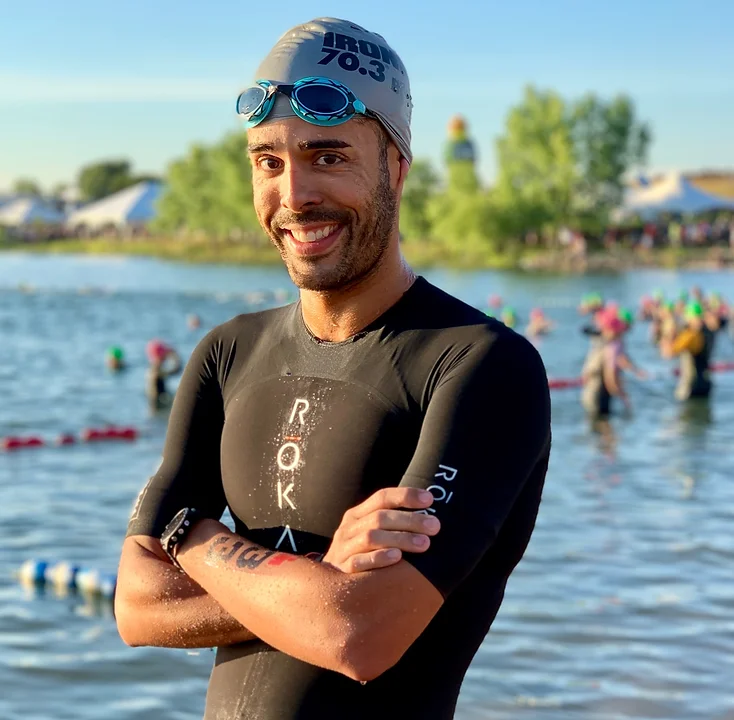 Breno MeloHead Coach · USA Triathlon, Road Runners Club of America, TrainingPeaks
Email me my fueling plan
Your hour-by-hour carbs, sodium and fluid plan as a printable race-day card.
No spam. Unsubscribe anytime. We never sell your email.
Position-stand daily intake ranges, scaled to body mass and training load
Carbohydrate 3–12 g/kg/day scaled to session load; protein 1.2–2.0 g/kg/day;
fat as the remaining energy, floored at roughly 20% of total intake.
- Body mass and training hours you enter are accurate.
- You have no clinical condition or prescribed diet that changes these ranges.
- These are population ranges from a professional position stand, not a personalised prescription.
- It does not account for pregnancy, RED-S, diabetes, kidney disease or eating-disorder history — see a registered dietitian.
- Language-model output is used for phrasing only; the numeric ranges are fixed by the cited position stand.
Athlete populations reviewed in the Academy of Nutrition and Dietetics / Dietitians of Canada / ACSM joint position stand.
Formula, constants and cited sources last verified on . Spotted something wrong? Email breno@brenoamelo.com and it gets corrected and dated.
How the fueling plan is built
Carbohydrate targets scale with race duration and intensity, capped by intestinal absorption rather than by appetite. Multiple transportable carbohydrates raise the ceiling.
Fluid replacement targets 70-100% of sweat losses; chasing 100% in a hot race usually causes more problems than the deficit would.
The model then converts targets into real products and a timing schedule, because grams per hour are useless without a plan for when to take them.
References
Every physiological claim on this page traces to one of the primary sources below — the original paper, textbook or governing-body standard, not a secondary write-up.
- 01Thomas DT, Erdman KA, Burke LM (2016). Position of the Academy of Nutrition and Dietetics, Dietitians of Canada, and the American College of Sports Medicine: Nutrition and Athletic Performance. Medicine & Science in Sports & Exercise 48(3):543–568. doi:10.1249/MSS.0000000000000852
- 02Jeukendrup AE (2014). A step towards personalized sports nutrition: carbohydrate intake during exercise. Sports Medicine 44(Suppl 1):S25–S33. doi:10.1007/s40279-014-0148-z
Using this page in your own work?
Copy a formatted reference below. If you are quoting a number from this page, please link back to it so readers can check the source and the date it was last reviewed.
Breno Melo, "AI Race Nutrition Planner — Breno Melo Endurance Coaching", Breno Melo Endurance Coaching (last reviewed 14 June 2026). https://www.brenoamelo.com/calculators/ai-nutrition
Marathon Fueling Strategy
Carbs per hour, gel timing and the gut training that makes it work.
Fueling the Long Ride
Bottle-by-bottle fueling for four hours and up.
The Heat Acclimation Protocol
Ten to fourteen sessions that buy back the pace heat takes away.
The 24-Week Ironman Build
What a full-distance block looks like from base to taper.
Fuelling is one session. Apex plans the other 200.
This plan covers one race day. Apex covers the block that gets you to it — the long sessions where you train the gut, and the week-by-week structure behind them.
- Fueling attached to the sessions where it matters
- A week of training built around your race, not a generic template
- Adaptive re-planning and in-app coach messaging
$9.99/month or $79.99/year. 14-day free trial. No card needed to start. Cancel in one click.
Want a coach to design fueling for your goal race?
These numbers are a starting point. 1:1 coaching builds your full race-week fueling protocol — tested across IRONMAN, marathon, and 70.3.
Boston-based · Trilingual EN/PT/ES · RRCA · USAT · TrainingPeaks L2 · 12× Boston qualifier