
Sweat & sodium loss calculator.
Build a race-day hydration plan from a real 60-minute sweat test. Sport-specific intake guidance for runners and cyclists, plus sodium target.
Race-day hydration plan
- • Target intake: 800 ml/hr (≈70% of sweat rate)
- • Drink every 15-20 min: ~229 ml per sip
- • Sodium target: 889 mg/hr
- • Test weight dropped 1.3% — target keeping race-day loss under 2-3%
- ⚠️ High sweat rate — pre-hydrate the morning of and add a sodium-rich pre-load
Frequently asked
Why do a sweat test?
It removes the guesswork from hydration. A 60-min test tells you your actual sweat rate so you can plan fluid and sodium for race day instead of hoping.
How do I conduct one accurately?
Weigh nude (or in minimal dry clothing) before exercise, track every ml of fluid you drink for 60 minutes at race intensity, then weigh again toweled-dry in the same outfit. Weight lost + fluid consumed = sweat loss.
What's a normal sweat rate?
0.5-2.0 L/hr. Runners typically lose 15-30% more than cyclists at the same effort because of reduced airflow and higher core temp.
How much sodium during exercise?
Average loss 500-1200 mg/L. Target 400-800 mg/hr for most; salty sweaters and hot days can push 1000+ mg/hr.
Can I drink too much?
Yes — hyponatremia is real. Replace 60-80% of losses, not 100%. Let thirst guide and keep total weight loss under 2-3%.
VDOT calculator
Jack Daniels race predictor and training paces — the run pacing your hydration plan supports.
Heat & humidity pace calculator
Adjust marathon and half pace for temperature and humidity using heat index.
Carb-loading calculator
Race-week carbs by bodyweight and distance — pair fuel and fluid for the start line.
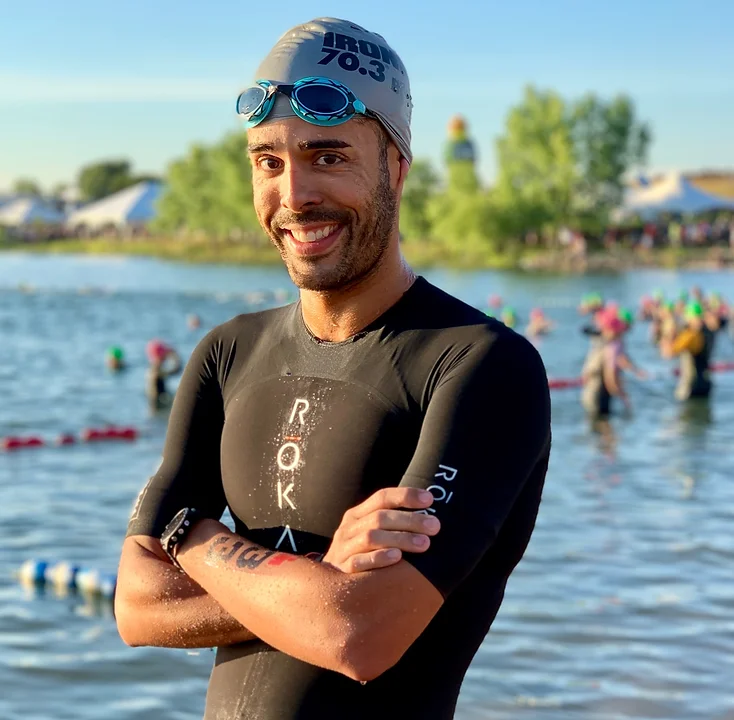 Breno MeloHead Coach · USA Triathlon, Road Runners Club of America, TrainingPeaks
Email me my hydration plan
Your sweat rate, hourly fluid target and sodium numbers on one printable card for the bottle cage.
No spam. Unsubscribe anytime. We never sell your email.
Gravimetric sweat-rate measurement with position-stand sodium ranges
Sweat rate (L/h) = ((body mass before − body mass after) + fluid consumed − urine passed) / duration in hours
Sodium loss (mg) = sweat volume (L) × sweat [Na+] (mg/L)
- You weighed nude, towel-dried, immediately before and after, on the same scale.
- 1 kg of body-mass change equals 1 L of sweat.
- Sweat sodium concentration is taken from published population ranges unless you enter a measured value.
- Sweat sodium concentration varies roughly 10–90 mmol/L between individuals — without a lab or patch test, any figure here is a band, not your number.
- Regional patch tests over-read whole-body concentration and need correction.
- A single session's sweat rate does not transfer to a different temperature, humidity or intensity.
- Substrate oxidation and respiratory water loss add a small error to the mass-balance assumption.
Athletes across multiple sports and climates in Baker's methodological review; ACSM fluid-replacement position stand cohorts.
Formula, constants and cited sources last verified on . Spotted something wrong? Email breno@brenoamelo.com and it gets corrected and dated.
How sweat rate is calculated
Body-mass change during exercise is almost entirely water, so a weigh-in either side of a timed session gives a direct sweat rate once you add back what you drank.
Sweat sodium concentration varies from roughly 200 to 2,000 mg/L between individuals and barely moves with training, which is why per-athlete numbers matter more than product labels.
Test in conditions that match your race. A 12°C sweat rate tells you nothing about July.
References
Every physiological claim on this page traces to one of the primary sources below — the original paper, textbook or governing-body standard, not a secondary write-up.
- 01Baker LB (2017). Sweating rate and sweat sodium concentration in athletes: a review of methodology and intra/interindividual variability. Sports Medicine 47(Suppl 1):111–128. doi:10.1007/s40279-017-0691-5
- 02Sawka MN, Burke LM, Eichner ER, Maughan RJ, Montain SJ, Stachenfeld NS (2007). American College of Sports Medicine position stand: Exercise and fluid replacement. Medicine & Science in Sports & Exercise 39(2):377–390. doi:10.1249/mss.0b013e31802ca597
Using this page in your own work?
Copy a formatted reference below. If you are quoting a number from this page, please link back to it so readers can check the source and the date it was last reviewed.
Breno Melo, "Sweat Rate & Sodium Calculator — Breno Melo Endurance Coaching", Breno Melo Endurance Coaching (last reviewed 14 June 2026). https://www.brenoamelo.com/calculators/sweat-sodium
The Heat Acclimation Protocol
Ten to fourteen sessions that buy back the pace heat takes away.
Marathon Fueling Strategy
Carbs per hour, gel timing and the gut training that makes it work.
Fueling the Long Ride
Bottle-by-bottle fueling for four hours and up.
Heat & Humidity Pace Chart
How much to slow down at every temperature and dew point.
Fuelling is one session. Apex plans the other 200.
You now know what you lose per hour. Apex plans the hours — the sessions where you rehearse it, the heat block that lowers it, and the race week it all points at.
- Fueling attached to the sessions where it matters
- A week of training built around your race, not a generic template
- Adaptive re-planning and in-app coach messaging
$9.99/month or $79.99/year. 14-day free trial. No card needed to start. Cancel in one click.
Hydration is solved. Now build the race plan.
Your sodium number means nothing without the workouts that test it. 1:1 coaching puts the bottle in the right hand at the right mile.
Boston-based · Trilingual EN/PT/ES · RRCA · USAT · TrainingPeaks L2 · 12× Boston qualifier