Running in Heat & Humidity: Free Pace Adjustment Chart (Dew Point + Temperature)
The exact pace adjustments to make when temperature and humidity climb. Includes a dew-point + temperature chart, why heat slows you down, and the rules elite coaches use on race day.
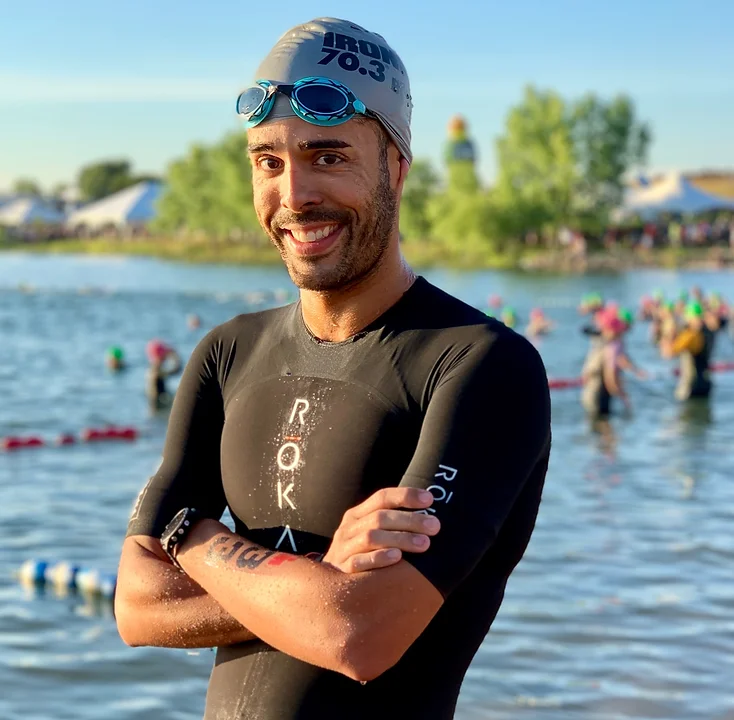 Breno MeloHead Coach · USA Triathlon, Road Runners Club of America, TrainingPeaks
Heat is the single biggest variable separating your training pace from your race pace. A goal time built in 50°F training collapses in 75°F race-day air — and the collapse is predictable. Below is the full pace-adjustment chart by dew point and temperature, the physiology behind why heat slows you down, and the rules I use with athletes on hot race days.
Why heat slows you down
14-day heat acclimation protocol
The exact 14-day exposure ladder, the pace adjustments to hold each day, and how to keep the adaptation once you have it.
No spam. Unsubscribe anytime.
Or apply for 1:1 coachingRunning generates heat — about 20× resting metabolic rate. Your body dumps that heat through sweat evaporation and convection. When air temperature rises, convection drops. When humidity rises, sweat evaporation drops. Core temperature climbs, heart rate climbs to deliver blood to skin for cooling, and aerobic capacity falls. Result: same effort = slower pace.
Dew point — not temperature — is the better predictor. Dew point is the temperature air must cool to before water condenses. Above 60°F dew point, sweat doesn't evaporate efficiently. Above 70°F dew point, it barely evaporates at all.
Dew point pace adjustment chart
Adjustment is applied to your goal race pace. Compounding factors (sun, no breeze, dehydration) make it worse.
- Dew point < 55°F — no adjustment, ideal racing conditions
- Dew point 55–59°F — +1% (≈ +5 sec/mi at 8:00 pace)
- Dew point 60–64°F — +2–3% (≈ +10–15 sec/mi at 8:00 pace)
- Dew point 65–69°F — +4–5% (≈ +20–25 sec/mi at 8:00 pace)
- Dew point 70–74°F — +6–8% (≈ +30–40 sec/mi at 8:00 pace)
- Dew point ≥ 75°F — +8–12%, consider lowering goal a full tier
Temperature pace adjustment (when dew point is unknown)
If you only know the temperature, use this rule of thumb. Add 2–4% to goal pace per 5°F above 60°F. Examples for a 3:00 marathoner (6:52/mi):
- 60°F — 6:52/mi (3:00:00)
- 65°F — 7:02/mi (3:04:18)
- 70°F — 7:13/mi (3:09:00)
- 75°F — 7:24/mi (3:13:42)
- 80°F — 7:34/mi (3:18:00)
- 85°F — 7:45/mi (3:22:42)
For a 4:00 marathoner (9:09/mi), the same chart looks like:
- 60°F — 9:09/mi (4:00:00)
- 65°F — 9:22/mi (4:05:30)
- 70°F — 9:36/mi (4:11:24)
- 75°F — 9:49/mi (4:17:00)
- 80°F — 10:02/mi (4:22:30)
- 85°F — 10:16/mi (4:28:30)
Adjusting training paces in heat
Training is harder than racing because effort, not pace, is the input. Use these rules:
- 01Easy runs: add 30–60 sec/mi when dew point > 60°F. Skip the watch, run by feel.
- 02Threshold workouts: hit T pace by HR, not by stopwatch. Expect 10–20 sec/mi slower than chart pace.
- 03Intervals: shorten reps or extend recovery. 5 × 1000m at I becomes 8 × 600m at the same effort.
- 04Long runs: split a long run into 2 short loops to refill bottles and ice.
- 05Tempo + heat = injury risk. If dew point > 70°F, move the workout to dawn or treadmill.
Race-day heat protocol
What I tell athletes the night before a hot race:
- Hydrate aggressively the 48 hours pre-race — add 1–2 g sodium daily, urine should be pale yellow
- Pre-cool: 500ml ice slurry 30 min before start drops core temp ~0.5°C and buys you ~15 min before heat overrides
- Goal pace down by the chart adjustment — write the slowed splits on your wrist or watch face
- Aid stations: water in, ice on head/neck, every single one — don't skip
- Wear white or light gray; ditch the hat unless you can keep ice in it
- Fueling stays the same — heat doesn't change carbohydrate needs
How to actually train for heat
Pace adjustment is damage control. The real solution is acclimation: 10–14 consecutive days of heat exposure (outdoor easy runs or post-run sauna 20–30 min) raises plasma volume, lowers core temp at given effort, and shrinks the pace penalty by 30–50%. Most age-group athletes leave 5–10 minutes on the table at hot marathons because they did all their training in 55°F basements.
Heat doesn't care about your fitness. It cares about your plasma volume and how many times you've made your body work in it.
Common heat-running mistakes
- 01Treating temperature as the only variable — dew point usually matters more
- 02Going out at goal pace and 'seeing how it feels' — you'll blow up by mile 18
- 03Skipping aid stations early because you feel fine — by the time you're thirsty, you're already cooked
- 04Hammering workouts in heat — you don't get tougher, you get injured
- 05No acclimation block before a hot goal race — 10–14 days of exposure is non-negotiable
Questions athletes ask about this
- What is a good dew point for running?
- Below 55°F is ideal. 55–60°F is comfortable for most runners. Above 65°F, performance declines start to be noticeable; above 70°F, every runner is affected regardless of fitness.
- How much should I slow down in heat?
- Roughly 2–4% per 5°F above 60°F if you only know temperature, or use the dew-point chart for a more accurate adjustment (1% per 5°F band of dew point above 55°F).
- Why is humidity worse than temperature?
- Humidity blocks sweat evaporation, which is your main cooling mechanism while running. A 70°F + 90% humidity day is harder on your body than 85°F + 30% humidity.
- Does acclimation actually work?
- Yes. 10–14 consecutive days of heat exposure raises plasma volume 4–15%, lowers core temperature at given effort, and reduces the heat pace penalty by 30–50%. Adaptations fade in 2–3 weeks without continued exposure.
- Should I use a treadmill on hot days?
- For quality workouts (intervals, tempo) when dew point > 70°F — yes. For easy runs and one long run per week — no, you need outdoor exposure for acclimation.
References
Every physiological claim on this page traces to one of the primary sources below — the original paper, textbook or governing-body standard, not a secondary write-up.
- 01Ely MR, Cheuvront SN, Roberts WO, Montain SJ (2007). Impact of weather on marathon-running performance. Medicine & Science in Sports & Exercise 39(3):487–493. doi:10.1249/mss.0b013e31802d3aba
- 02Vihma T (2010). Effects of weather on the performance of marathon runners. International Journal of Biometeorology 54(3):297–306. doi:10.1007/s00484-009-0280-x
- 03Périard JD, Racinais S, Sawka MN (2015). Adaptations and mechanisms of human heat acclimation: applications for competitive athletes and sports. Scandinavian Journal of Medicine & Science in Sports 25(S1):20–38. doi:10.1111/sms.12408
Want this kind of thinking applied to your training?
Free 20-minute call. We'll talk about your race, your timeline, and whether 1:1 coaching is the right next step.
Book a discovery callEndurance coach since 2015. RRCA-certified, USAT Level II, TrainingPeaks Level 2. 12× Boston Marathon qualifier. Based in Fenway, Boston — coaching athletes worldwide in English, Portuguese, and Spanish.

Jack Daniels VDOT: The Complete Guide to Training Paces That Actually Work
What VDOT really measures, how to calculate yours from a recent race, and how to translate it into easy, threshold, interval, and repetition paces.