
Marathon pace calculator & BQ check.
Free marathon pace calculator. Enter your goal marathon time to get target per-km and per-mile pace, 5K splits, a Boston Qualifying check by age and gender, and a path into a structured marathon training plan.
Meeting the standard does not guarantee entry. The 2026 race accepted qualifiers only 4:34 or more under the standard. Aim 5:00 under. Full Boston qualifier calculator.
Marathon Pace: How to Pick a Goal You Can Actually Run
Volume-adjusted Riegel, BQ reality checks, and race-day pacing rules.
Jack Daniels VDOT: The Complete Guide
Turn one recent race into every training pace you need.
Zone 2: Why Slow Training Builds Fast Athletes
Your easy days dictate your marathon back half — here's how to do them right.
Ironman & 70.3 Time Predictor
How standalone marathon times translate (and don't) to long-course splits.
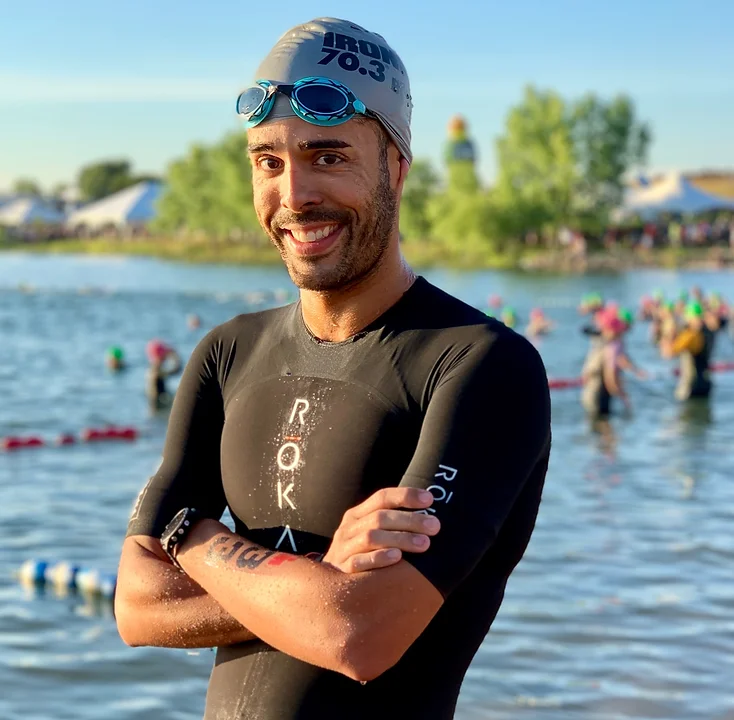 Breno MeloHead Coach · USA Triathlon, Road Runners Club of America, TrainingPeaks
Email me my marathon splits
Your goal pace, 5K splits for the whole race, and the halfway target that keeps you off the wall.
No spam. Unsubscribe anytime. We never sell your email.
VDOT marathon-pace band cross-checked against a Riegel projection
Goal pace = 42.195 km ÷ target time; feasibility checked against VDOT marathon pace and Riegel T2.
- Your goal is supported by completed long-run and threshold volume, not just by ambition.
- Even pacing, which is the fastest way to run a marathon for almost every athlete.
- A pace band cannot tell you whether you have the durability to hold it past 30 km.
- No adjustment for heat, hills or wind is applied here.
Trained distance runners (Daniels cohorts); Riegel exponent from pooled record data.
Formula, constants and cited sources last verified on . Spotted something wrong? Email breno@brenoamelo.com and it gets corrected and dated.
How marathon pace is calculated
Goal time is divided by the exact distance rather than a rounded 42 km, which is worth several seconds per kilometre.
The split table assumes even effort. On a rolling course, run even effort rather than even pace and expect the first half to be 30-60 seconds slower than the second-half target.
The Boston check compares your goal against the current BAA standard for your age and division, plus the buffer recent cutoffs support.
References
Every physiological claim on this page traces to one of the primary sources below — the original paper, textbook or governing-body standard, not a secondary write-up.
- 01Daniels J (2021). Daniels' Running Formula, 4th edition. Human Kinetics, Champaign, IL. ISBN 978-1-4925-7443-2
- 02Riegel PS (1981). Athletic records and human endurance. American Scientist 69(3):285–290. JSTOR 27850427
Free to use on your own site
Running club, race site, coaching blog — paste this snippet and your readers get the marathon pace calculator without leaving your page. It resizes itself to fit and keeps a credit link back here. No sign-up, no tracking script, no cost.
<iframe
  id="bm-embed-marathon-pace"
  src="https://www.brenoamelo.com/embed/marathon-pace"
  title="Marathon Pace Calculator by Breno Melo Endurance Coaching"
  width="100%"
  height="560"
  loading="lazy"
  style="border:0;width:100%;max-width:680px"
></iframe>
<script>
  window.addEventListener("message", function (e) {
    if (e.origin !== "https://www.brenoamelo.com") return;
    if (!e.data || e.data.type !== "bm-embed-height" || e.data.slug !== "marathon-pace") return;
    var f = document.getElementById("bm-embed-marathon-pace");
    if (f) f.height = e.data.height;
  });
</script>Using this page in your own work?
Copy a formatted reference below. If you are quoting a number from this page, please link back to it so readers can check the source and the date it was last reviewed.
Breno Melo, "Marathon Pace Calculator — Breno Melo Endurance Coaching", Breno Melo Endurance Coaching (last reviewed 18 May 2026). https://www.brenoamelo.com/calculators/marathon-pace
Adjust those splits for race-day heat
Goal pace assumes cool conditions. If race morning is warm, the honest target is slower — this shows by how much.
That is your goal pace. Here is the 16 weeks that gets you there.
A goal pace is a hypothesis. Apex builds the marathon block that tests it — long runs, marathon-pace work, fueling rehearsals and a taper, all pinned to your race date.
- A full training week generated from the numbers on this page
- Sessions that re-plan themselves when you miss one or feel wrecked
- Check-ins, streaks and a coach you can message inside the app
$9.99/month or $79.99/year. 14-day free trial. No card needed to start. Cancel in one click.
Boston-qualified for a reason: pacing is taught, not guessed.
Pace charts get you to the start line. A coach gets you across the finish on the pace you trained for — even when the wheels start wobbling at mile 20.
Boston-based · Trilingual EN/PT/ES · RRCA · USAT · TrainingPeaks L2 · 12× Boston qualifier
Frequently asked
What's a realistic marathon goal pace from my half marathon time?
Multiply your half marathon time by 2.1 (not 2.0) for a typical fitness-matched marathon. So a 1:30 half ≈ 3:09 marathon, a 1:45 half ≈ 3:40, a 2:00 half ≈ 4:12. If your weekly mileage is under 50km, push the multiplier to 2.15–2.20 — fade in the back half is a fueling and durability problem, not just fitness.
What pace do I need to run to qualify for Boston?
Men 18–34 need 2:55:00 (4:09/km · 6:40/mi); women and non-binary athletes 18–34 need 3:25:00 (4:52/km · 7:49/mi). Standards ease with age. Because Boston cuts off above the standard — the 2026 race required 4:34 — plan on a 5:00 buffer. Use the in-page BQ check for your exact age-group target.
Should I run negative splits or even pace?
Even pace is the most efficient strategy on flat courses. Aim for the first half to be 30–90 seconds slower than the second (slight positive split is normal). True negative splits require holding back 5–10 sec/km early — only attempt if you've practiced it in long-run race-pace segments.
How much fueling do I need at marathon pace?
60–90 g of carbs per hour, starting at minute 30. That's roughly 2 gels per hour for most athletes, or 500–750ml of sports drink. Practice this exact protocol on every long run — most marathon blow-ups at mile 20+ are glycogen depletion, not lack of fitness.
Can I really hold marathon pace for 26.2 miles off this training?
Honest test: can you run 30km (18.6mi) at goal pace + 10 seconds/km in a long workout? If yes, the pace is realistic. If you can't string together 25–30km of quality work in training, the calculator's goal pace will fall apart between miles 18–22. Adjust the goal, or extend the build.