IRONMAN Kona coaching
A hot long-course race needs practiced fueling, careful effort control and preparation for the conditions. I build those habits into the block rather than adding them in race week. We use split scenarios to organize decisions, then adjust to the actual day. A calculator cannot know your acclimatization or your stomach.
FIELD NOTES · 20 SECONDS
Manage the whole day.
A short visual explanation before you work through the details.
The drawings illustrate pacing decisions. They are not measured elevation profiles or navigation maps.
2025 athlete guide · prior editionRead the transcript
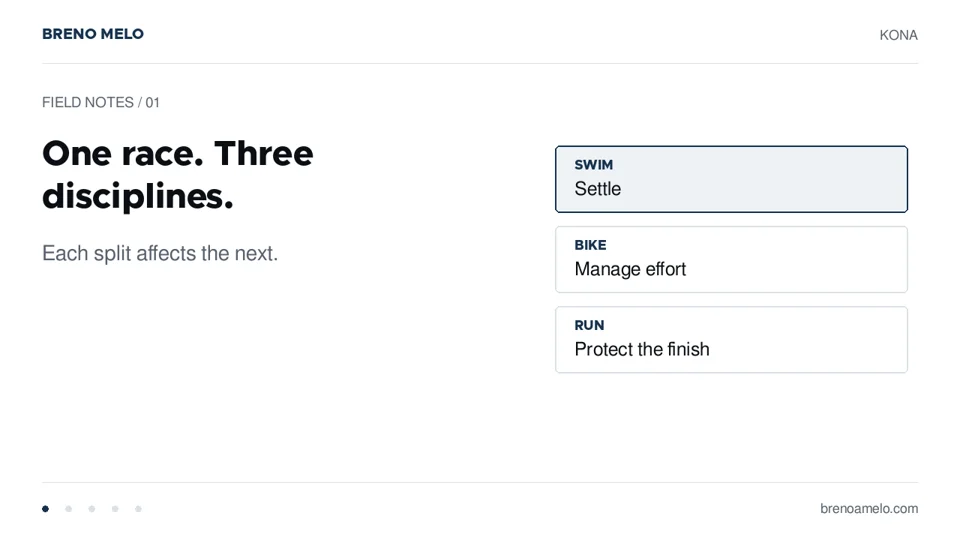
Kona is more than three separate splits. Settle into the swim. Manage bike effort as wind changes. Protect the run with practiced pacing and fueling. Use your sweat test and the actual conditions to plan fluids, not another athlete's numbers.
 Watch the field note Close the video
Review the current course map before setting your pacing and equipment plan.
01 · Swim
Practice sighting, the start and the equipment you will use.
02 · Bike
Set effort that leaves room for the run; avoid repeated spikes.
03 · Run
Begin with control. Follow the fueling plan you have tested.
04 · Transitions
Rehearse the sequence. An organized transition is free concentration.
What should I plan before race week?
Check the current athlete guide for route changes, check-in, cutoffs, gear drop and aid-station supplies. Do not use an old guide as a race-day instruction.
Weather belongs in the strategy.
Use the event’s current forecast close to race day. A climate average is not a forecast, and a city-wide monthly average is not race-start weather. Where historical measurements are available, the table identifies what the organizer recorded and what the source leaves unspecified.
How conditions change effortMake the arithmetic useful.
Use a recent result and your practiced fueling to organize the race plan. A calculator can clarify a target; it cannot establish your readiness.
Questions, answered.
How should I pace IRONMAN Kona?
Practice sighting, the start and the equipment you will use. Set effort that leaves room for the run; avoid repeated spikes. Begin with control. Follow the fueling plan you have tested. Rehearse the sequence. An organized transition is free concentration.
Is a calculated time a race guarantee?
No. Race models and split scenarios cannot establish durability, fueling tolerance or the weather on your day.
Which course guide should I use?
Use the current official edition. Old maps and guides are context, not instructions for this year’s logistics.
What should I practice before the race?
Pacing, fueling, equipment and the decisions you will need under fatigue. The preparation should fit the event and your starting point.
Can we review my race strategy?
Yes. Book a free discovery call to discuss the goal and whether personal coaching fits.