Sweat-rate calculator
Sweat rate is estimated from pre- and post-exercise body mass, fluid consumed, urine passed and session duration. Measure in similar conditions more than once to get a useful range. The calculation does not measure sweat sodium and does not tell you to replace every drop. Use it to inform a practiced drinking plan.
Your result, in detail.
Review the assumptions before turning a calculation into a target.
| Measure | Value |
|---|---|
| Sweat rate · US | 39.0 US fl oz/hour |
| Sweat rate · metric | 1.15 L/hour |
| Per hour | 1154 mL/hour |
| Estimated session sweat loss | 1.15 L |
| Body mass change | 1.50 lb |
| Fluid consumed | 16.0 US fl oz |
| Urine passed | 0.0 US fl oz |
Worked comparison
How much does a missing drink entry change the estimate?
Each example uses the same before and after weights and the same one-hour session. Logging fluid consumed changes the implied sweat loss. Confirm what you actually drank before using the estimate to plan another session.
Fluid consumed Result
Open an example to see or change its inputs.
Fluid consumed Result
Open an example to see or change its inputs.
FIELD NOTES · 30 SECONDS
Measure. Repeat. Plan.
A short visual explanation before you work through the details.
Use the number as a starting point. The full method and its limits are below.
Calculator methods and limitationsRead the transcript
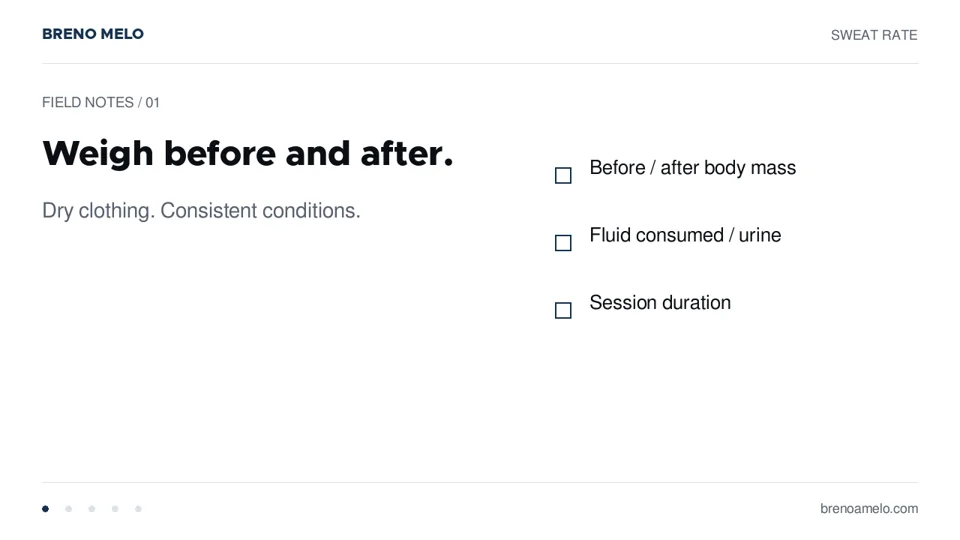
Weigh yourself before and after a training session using dry clothing or consistent conditions. Record how much you drank, any urine passed, and the session duration. Body mass lost, plus fluid consumed, minus urine, estimate sweat loss. Divide by time to get a rate. Repeat in similar weather. Sweat rate does not measure sodium loss or prescribe drinking every drop back.
 Watch the field note Close the video
Why this number?
A tool from Breno Melo Endurance Coaching. Meet the coach.
How this is calculated
Sweat L/hour ≈ (pre kg − post kg + consumed L − urine L) / duration hours.
How do I use it?
Weigh before and after in dry, comparable conditions; record drinks, urine and elapsed exercise time.
US mode uses pounds and US fluid ounces; metric uses kilograms and liters. Repeat the measurement in comparable weather. Sweat volume does not establish sodium concentration.
- Enter recent, representative values.
- Choose units and check the assumptions.
- Review the result and its context.
- Copy, share or print the output.
Public inputs are encoded in share links. Check what you are sharing.
Questions, answered.
How much do I sweat per hour?
Sweat rate is estimated from pre- and post-exercise body mass, fluid consumed, urine passed and session duration. Measure in similar conditions more than once to get a useful range. The calculation does not measure sweat sodium and does not tell you to replace every drop. Use it to inform a practiced drinking plan.
Do I count fluid I drank?
Yes. The mass-balance estimate adds consumed fluid to body-mass loss and subtracts measured urine output. Use consistent measurement units.
Does this measure sweat sodium?
No. Sweat volume does not establish its sodium concentration. The tool does not invent a sodium prescription from sweat rate.
What does the result assume?
Sweat L/hour ≈ (pre kg − post kg + consumed L − urine L) / duration hours.
Is this an exact prediction?
Arithmetic conversions are exact within input precision. Physiology models and planning scenarios are estimates; use the assumptions and your training response.
Can I change units or share this result?
Yes. Unit preference is remembered on this device. The share link includes calculator inputs; review them before sharing.
Do I need an email address?
No. Results, methodology and printable output are available without an email wall.
UNDERSTAND THE RESULT
Read the coaching context.
Use these guides to understand the assumptions and apply the result to your training.
Have a measured sweat sodium concentration as well as a sweat rate? Estimate sodium loss over your session.