Boston Marathon coaching
Boston starts downhill, asks for patience through Newton and gives you a long way to defend tired legs. A good race plan uses effort on the hills and pace on the flats. I build your preparation around your current fitness, your qualifying standard and the hours you can train.
FIELD NOTES · 20 SECONDS
Protect the second half.
A short visual explanation before you work through the details.
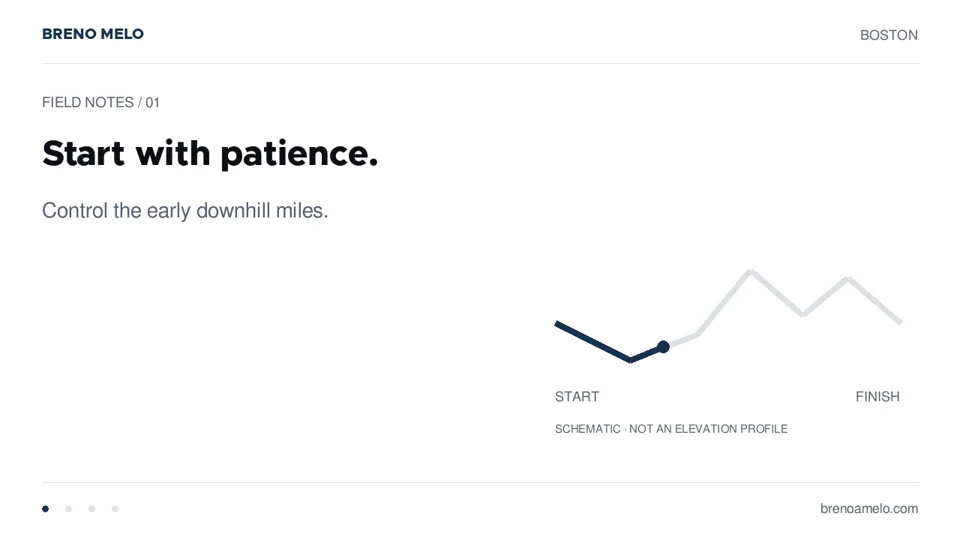
The drawings illustrate pacing decisions. They are not measured elevation profiles or navigation maps.
Official course informationRead the transcript
Boston rewards patience. Control the early downhill miles. Through the Newton Hills, let pace change instead of forcing the watch. Save your legs for the finish. Your plan should follow effort, current fitness, and race-day conditions.
 Watch the field note Close the video
Hopkinton → Boston
Official course & athlete informationView elevation data
| Distance (mi) | Elevation (ft) |
|---|---|
| 0 | 475 |
| 1 | 354 |
| 2 | 302 |
| 3 | 254 |
| 4 | 183 |
| 5 | 191 |
| 6 | 175 |
| 7 | 161 |
| 8 | 158 |
| 9 | 149 |
| 10 | 165 |
| 11 | 191 |
| 12 | 143 |
| 13 | 148 |
| 14 | 136 |
| 15 | 164 |
| 16 | 53 |
| 17 | 102 |
| 18 | 142 |
| 19 | 108 |
| 20 | 143 |
| 21 | 228 |
| 22 | 151 |
| 23 | 119 |
| 24 | 30 |
| 25 | 30 |
| 26 | 18 |
| 26.2 | 16 |
01 · Start to Wellesley
Let the downhill go. Hold back on effort; early time gained can become late time lost.
02 · Wellesley to Newton
Keep fueling on schedule. Prepare for the change in terrain before the legs feel it.
03 · Newton hills
Let pace vary with grade. Don’t turn a climb into a threshold test.
04 · Brookline to Boylston
Reassess after the hills. Commit to an effort you can carry through the finish.

What should I plan before race week?
Use the B.A.A. runner guide for transport to Hopkinton, start-area procedures and your assigned wave. Plan clothing for the wait as well as the race.
How variable has Boston weather been?
| Year | Hopkinton °F | Boston °F | Conditions |
|---|---|---|---|
| 2018 | 38 | 46 | Rain |
| 2019 | 58 | 61 | Overcast / partly rain |
| 2022 | 54 | 66 | Clear |
These selected editions show why a Boston plan needs options for cold rain and warmer conditions. They do not establish the likely weather for your race.
B.A.A. media guideWeather belongs in the strategy.
Use the event’s current forecast close to race day. A climate average is not a forecast, and a city-wide monthly average is not race-start weather. Where historical measurements are available, the table identifies what the organizer recorded and what the source leaves unspecified.
How conditions change effortMake the arithmetic useful.
Use a recent result and your practiced fueling to organize the race plan. A calculator can clarify a target; it cannot establish your readiness.
2027 qualifying cutoff: 5:17 faster than the standard. Official B.A.A. rules. Future cutoffs are unknown.
Questions, answered.
How should I pace Boston Marathon?
Let the downhill go. Hold back on effort; early time gained can become late time lost. Keep fueling on schedule. Prepare for the change in terrain before the legs feel it. Let pace vary with grade. Don’t turn a climb into a threshold test. Reassess after the hills. Commit to an effort you can carry through the finish.
Is a calculated time a race guarantee?
No. Race models and split scenarios cannot establish durability, fueling tolerance or the weather on your day.
Which course guide should I use?
Use the current official edition. Old maps and guides are context, not instructions for this year’s logistics.
What should I practice before the race?
Pacing, fueling, equipment and the decisions you will need under fatigue. The preparation should fit the event and your starting point.
Can we review my race strategy?
Yes. Book a free discovery call to discuss the goal and whether personal coaching fits.