
Triathlon calculator — Sprint to Ironman.
Free triathlon calculator and Ironman time calculator. Pick a distance — Sprint, Olympic, 70.3 / medio Ironman or Full Ironman — plug in your swim, bike and run pacing, and we'll estimate your splits and total finish time.
Ironman & 70.3 Time Predictor: Realistic Forecasting
Why most long-course predictions are wildly optimistic — and the inputs that actually matter.
The Taper Myth
Why most age-group triathletes blow the taper — and how to enter race week sharp.
Heart Rate vs Power vs Pace
Which metric should anchor each leg of your race? Use this with the time predictor.
Jack Daniels VDOT: The Complete Guide
Translate any race into prescription-grade training paces with the most useful number in distance running.
VDOT calculator
Jack Daniels race predictor for runners — translate any race into all 5 training paces (Easy, Marathon, Threshold, Interval, Repetition).
Ironman time predictor
Dedicated full Ironman calculator with bike-fade and run-fade modeling for IM distance.
Half Ironman (70.3) predictor
70.3-specific finish-time predictor with transitions baked in — metric or imperial.
AI race-day nutrition plan
Personal carbs/hr, sodium and fluids plan — the fueling side of any IM/70.3 prediction.
Carb loading calculator
Race-week carbs to bank for a 70.3 or full Ironman without GI distress.
Sweat & sodium calculator
Bottle-by-bottle hydration plan that protects the predicted run split.
Triathlon coach
1:1 coaching across sprint, Olympic, 70.3 and full IRONMAN.
IRONMAN 70.3 coach
16–24 week 70.3 builds with course-specific brick work.
Marathon coach
Turn the predicted split into a real PR — pacing, fueling, taper.
Online triathlon coach
Fully remote 1:1 coaching for triathletes worldwide.
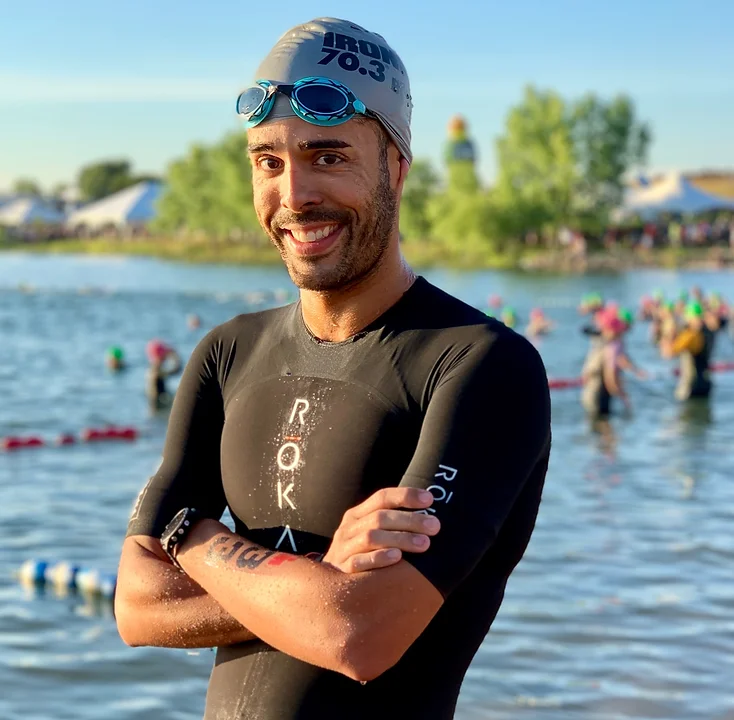 Breno MeloHead Coach · USA Triathlon, Road Runners Club of America, TrainingPeaks
Email me my predicted times
Your predicted times across every distance from 1500 m to the marathon, on one printable page.
No spam. Unsubscribe anytime. We never sell your email.
Riegel endurance exponent
T2 = T1 × (D2 / D1)^1.06
- The 1.06 fatigue exponent applies to you — it was fitted to pooled race records, not to an individual.
- You are appropriately trained for the target distance, not just for the distance you entered.
- Predicting a marathon from a 5K is where this model fails hardest: it assumes endurance you may not have built.
- Real exponents range from about 1.02 for high-volume marathoners to 1.10+ for speed-biased runners.
- It ignores course profile, weather, fuelling and pacing discipline — all of which dominate the marathon.
Pooled world and national record performances across running, swimming and cycling, 1981 — an elite dataset, not recreational athletes.
Formula, constants and cited sources last verified on . Spotted something wrong? Email breno@brenoamelo.com and it gets corrected and dated.
How the predictions are calculated
Riegel's exponent of 1.06 captures how much you slow as distance doubles. It is accurate over a 2-3x range and optimistic beyond it.
The Daniels-Gilbert route converts your result into a VDOT score and solves for the time at the new distance, which handles very short and very long extrapolations better.
Neither model knows whether you have done the endurance work. Treat a marathon predicted from a 5K as a ceiling, not a plan.
References
Every physiological claim on this page traces to one of the primary sources below — the original paper, textbook or governing-body standard, not a secondary write-up.
- 01Riegel PS (1981). Athletic records and human endurance. American Scientist 69(3):285–290. JSTOR 27850427
- 02Daniels J (2021). Daniels' Running Formula, 4th edition. Human Kinetics, Champaign, IL. ISBN 978-1-4925-7443-2
Free to use on your own site
Running club, race site, coaching blog — paste this snippet and your readers get the race time predictor without leaving your page. It resizes itself to fit and keeps a credit link back here. No sign-up, no tracking script, no cost.
<iframe
  id="bm-embed-race-predictor"
  src="https://www.brenoamelo.com/embed/race-predictor"
  title="Race Time Predictor by Breno Melo Endurance Coaching"
  width="100%"
  height="560"
  loading="lazy"
  style="border:0;width:100%;max-width:680px"
></iframe>
<script>
  window.addEventListener("message", function (e) {
    if (e.origin !== "https://www.brenoamelo.com") return;
    if (!e.data || e.data.type !== "bm-embed-height" || e.data.slug !== "race-predictor") return;
    var f = document.getElementById("bm-embed-race-predictor");
    if (f) f.height = e.data.height;
  });
</script>Using this page in your own work?
Copy a formatted reference below. If you are quoting a number from this page, please link back to it so readers can check the source and the date it was last reviewed.
Breno Melo, "Race Time Predictor — Breno Melo Endurance Coaching", Breno Melo Endurance Coaching (last reviewed 18 May 2026). https://www.brenoamelo.com/calculators/race-predictor
Turn that prediction into training paces
A predicted finish is only useful once it tells you how fast to run on Tuesday. VDOT converts it into every training zone.
That is your predicted time. Apex builds the training that makes it real.
A prediction assumes you are trained for the distance. You usually are not. Apex writes the specific block — long runs, threshold volume, race-pace work — that closes the gap.
- A full training week generated from the numbers on this page
- Sessions that re-plan themselves when you miss one or feel wrecked
- Check-ins, streaks and a coach you can message inside the app
$4.99/month or $49.99/year. 14-day free trial. No card needed to start. Cancel in one click.
Want a 70.3 or full Ironman build, not just a finish-time guess?
Predictions only matter if the swim, bike and run all hold up on race day. Coaching turns these splits into a periodized 16–24 week plan with course-specific brick work and fueling.
Boston-based · Trilingual EN/PT/ES · RRCA · USAT · TrainingPeaks L2 · 12× Boston qualifier
Frequently asked
How accurate is this triathlon time calculator?
It uses your real swim, bike and run paces (no fitness assumptions) plus realistic transition defaults, so for Sprint and Olympic it's typically within 2–3%. For 70.3 and Ironman, accuracy depends on whether you can actually hold those splits for 4–12 hours — most athletes overestimate sustainable bike power and run pace by 5–10% at the long distances.
What's a realistic Ironman finish time for a first-timer?
Most first-time Ironman finishers come in between 12:30 and 14:30. Aim for: 1:15–1:45 swim (1.5–2.3 min/100m), 6:00–7:00 bike (26–30 km/h average), 4:30–5:30 run (6:25–7:45 min/km) plus 10–15 min of transitions. Sub-12 requires sub-7 bike + sub-4:30 run consistently.
Should I plan to ride my FTP on race day?
No. For 70.3 target 75–82% of FTP (intensity factor 0.78–0.85). For full Ironman target 65–75% of FTP (IF 0.68–0.78). Going harder almost always blows up the run — fast bike splits cost more time than they save when you walk the marathon.
How do transitions affect my finish time?
T1 (swim→bike) typically takes 2–4 min for age-groupers, T2 (bike→run) 1–3 min. Across an Ironman that's 4–7 minutes — meaningful but tiny vs the bike+run pacing decision. Beginners often lose 5–10 minutes here; practicing transitions is the cheapest time you'll find.
Why is my predicted Ironman run pace so much slower than my open marathon?
After 180km on the bike, most athletes run 25–45 seconds per km slower than their fresh standalone marathon pace. The calculator already assumes that fade — if you enter your standalone marathon pace, your real Ironman split will be longer. Use a brick-workout pace as the input for the most realistic forecast.