
Altitude pace calculator.
Thin air costs you aerobic power, and the cost grows with both elevation and race distance. Convert your sea-level pace into what the same effort is actually worth at altitude — with credit for the time you have spent up there.
0 = flying in the day before. 21+ = fully credited acclimatisation.
What this elevation costs a runner arriving straight from sea level.
Acclimatisation returns up to half the deficit across three weeks.
Marathon pace penalty by elevation
| Elevation | Example | Unacclimatised | 3 weeks in |
|---|---|---|---|
| 3,000 ft | Flagstaff foothills | 0.0% slower | 0.0% slower |
| 4,500 ft | Salt Lake City | 2.6% slower | 1.3% slower |
| 5,280 ft | Denver | 4.0% slower | 2.0% slower |
| 6,000 ft | Colorado Springs | 5.3% slower | 2.6% slower |
| 7,000 ft | Flagstaff, AZ | 7.0% slower | 3.5% slower |
| 8,000 ft | Mammoth Lakes, CA | 8.8% slower | 4.4% slower |
| 9,500 ft | Leadville, CO | 11.4% slower | 5.7% slower |
Marathon figures. Shorter races carry a smaller share of the loss — a mile is penalised at roughly 55% of these numbers.
Frequently asked
How much slower do you run at altitude?
Above roughly 3,000 ft, expect about 1.5–2% of your VO₂max per additional 1,000 ft of elevation. For an unacclimatised runner that works out to roughly 2–3% slower over a marathon at 5,000 ft and 6–8% slower at 8,000 ft. Shorter races lose less because they lean less on aerobic power.
At what altitude does running performance start to suffer?
Measurable aerobic decline starts surprisingly low — around 2,000–3,000 ft for hard efforts — but it is small enough to ignore until about 3,000 ft. Above 5,000 ft it is unmistakable, and above 8,000 ft it dominates pacing decisions.
How long does it take to acclimatise to altitude?
Ventilatory changes happen within days, plasma volume normalises over one to two weeks, and red-cell mass responds over three to four weeks. Most runners recover roughly half of the initial performance loss inside three weeks; you never fully recover sea-level pace while you remain at altitude.
Is it better to arrive right before an altitude race or weeks early?
Either extreme beats the middle. Racing inside the first 24–36 hours gets you in before the worst of the acute plasma-volume drop and sleep disruption. Otherwise, arrive at least two to three weeks out. Days 3 to 10 are usually the worst window to race in.
Does altitude training make you faster at sea level?
It can, most reliably with a live-high, train-low structure that preserves sea-level session quality while raising red-cell mass. Living and training high at full intensity usually degrades workout quality enough to cancel the benefit.
Are short races also slower at altitude?
Less so, and sprints are actually faster. Thinner air means less aerodynamic drag, which is why sprint and jump records favour altitude venues. The crossover sits somewhere around 800m to 1500m.
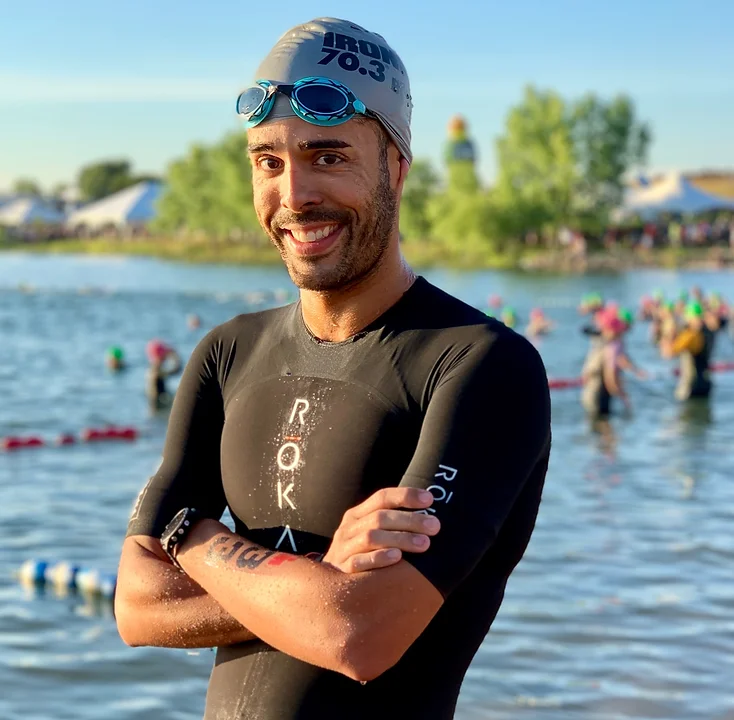 Breno MeloHead Coach · USA Triathlon, Road Runners Club of America, TrainingPeaks
Email me my altitude pace card
Altitude pace penalties by elevation and distance, plus the acclimatisation timeline, on one printable card.
No spam. Unsubscribe anytime. We never sell your email.
Altitude-adjusted running pace from the VO2max decline above 1,000 m
Above ~1,000 m, VO2max falls roughly 1.5–2% per additional 300 m of elevation.
Adjusted pace ≈ sea-level pace ÷ (1 − VO2max decline × distance-duration factor).
The penalty grows with race duration: longer events spend longer in the hypoxic deficit.
- You are unacclimatised, or early in an acclimatisation block.
- The effort is aerobic and continuous — the model is not written for repeated sprints.
- Conditions other than altitude (heat, wind, terrain) are held equal.
- Individual response to hypoxia varies widely; some athletes lose far more than the group mean.
- Below roughly 1,000 m the effect is within day-to-day noise and the model returns no meaningful penalty.
- Acclimatisation recovers part, never all, of the loss — plan for a residual penalty even after two to three weeks.
- It does not model the thinner air's small aerodynamic benefit, which slightly offsets the cost in short, fast events.
VO2max-versus-altitude regressions in trained endurance athletes, plus the theoretical running-performance model of Péronnet and colleagues.
Formula, constants and cited sources last verified on . Spotted something wrong? Email breno@brenoamelo.com and it gets corrected and dated.
How the altitude adjustment is calculated
Lower barometric pressure reduces the oxygen your blood can carry, so maximal aerobic power falls. The widely used field estimate is roughly 1.5–2% of VO₂max per 1,000 ft above about 3,000 ft; this tool uses 1.75%.
Acclimatisation recovers part — not all — of that loss. Most of the haematological adaptation lands inside three weeks, and this model credits back up to half the deficit on a 21-day ramp.
Longer races are hurt more because they sit closer to your aerobic ceiling for longer. A mile is penalised at about 55% of the VO₂max loss, a marathon at essentially 100%. Very short events can even be slightly faster because thinner air means less drag.
This is a planning model, not a lab measurement. Individual altitude response varies widely, and native altitude residents behave very differently from visitors.
References
Every physiological claim on this page traces to one of the primary sources below — the original paper, textbook or governing-body standard, not a secondary write-up.
- 01Péronnet F, Thibault G, Cousineau DL (1991). A theoretical analysis of the effect of altitude on running performance. Journal of Applied Physiology 70(1):399–404. doi:10.1152/jappl.1991.70.1.399
- 02Bassett DR, Kyle CR, Passfield L, Broker JP, Burke ER (1999). Comparing cycling world hour records, 1967–1996: modeling with empirical data. Medicine & Science in Sports & Exercise 31(11):1665–1676 — includes the altitude VO2max decline model. doi:10.1097/00005768-199911000-00025
- 03Daniels J (2021). Daniels' Running Formula, 4th edition. Human Kinetics, Champaign, IL. ISBN 978-1-4925-7443-2
Using this page in your own work?
Copy a formatted reference below. If you are quoting a number from this page, please link back to it so readers can check the source and the date it was last reviewed.
Breno Melo, "Altitude Pace Calculator — Breno Melo Endurance Coaching", Breno Melo Endurance Coaching (last reviewed 1 September 2026). https://www.brenoamelo.com/calculators/altitude-pace
The Heat Acclimation Protocol
Ten to fourteen sessions that buy back the pace heat takes away.
Heat & Humidity Pace Chart
How much to slow down at every temperature and dew point.
Zone 2: Why Slow Training Builds Fast Athletes
Easy pace is the engine room of every PR — here is how to use it.
How to Set a Realistic Marathon Goal Pace
The difference between a goal you want and a goal your training supports.
Altitude changes the paces. It should change the plan too.
A camp or a mountain race is not a sea-level block run higher. Apex rebuilds the paces, the recovery and the session density around where you are actually training.
- A full training week generated from the numbers on this page
- Sessions that re-plan themselves when you miss one or feel wrecked
- Check-ins, streaks and a coach you can message inside the app
$9.99/month or $79.99/year. 14-day free trial. No card needed to start. Cancel in one click.
Altitude rewards a plan, not a guess.
1:1 coaching sets the arrival window, the intensities and the taper so the mountain race goes the way you intended.
Boston-based · Trilingual EN/PT/ES · RRCA · USAT · TrainingPeaks L2 · 12× Boston qualifier