
CSS calculator & swim zones.
Derive Critical Swim Speed from two time trials, get five training zones in pool intervals, and predicted 70.3 and Ironman swim splits.
Swim training zones
Frequently asked
What is Critical Swim Speed (CSS)?
CSS is your lactate-threshold pace in the water — the fastest pace you can hold for 30-60 minutes. It anchors every swim training zone.
How do I test it?
After a thorough warmup, swim two all-out time trials at different distances (e.g. 200 then 400, with 10-15 min rest). Plug in distance and time for each — CSS is the velocity between them.
What distances should I use?
200/400 m, 100/200 yd, or 300/600 m. The longer trial should be roughly 2× the shorter one, and both should land between 2-8 minutes.
How accurate are the 70.3 / IM swim splits?
They assume open water with wetsuit and decent pacing. Real splits depend on chop, drafting and wetsuit fit.
How often should I retest CSS?
Every 6-8 weeks during a block, or at the start of every race-specific phase.
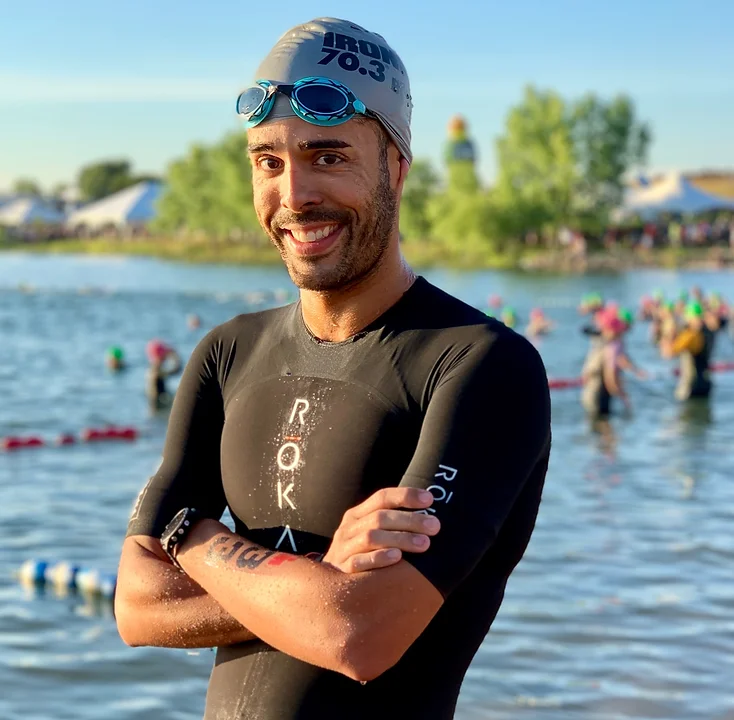 Breno MeloHead Coach · USA Triathlon, Road Runners Club of America, TrainingPeaks
Email me my CSS zones
Your CSS pace, five swim zones and target interval times on one printable poolside card.
No spam. Unsubscribe anytime. We never sell your email.
Critical swim speed (Wakayoshi critical velocity)
CSS (m/s) = (400 − 200) / (T400 − T200)
CSS pace per 100 m = 100 / CSS
- Both time trials were maximal, from a push start, in the same pool and on the same day, with full recovery between.
- The two-point distance–time relationship is linear over 200–400 m.
- Two data points mean a single mis-paced trial corrupts the result — a 200 m swum conservatively inflates CSS.
- It is a pool metric. Open water adds sighting, wetsuit buoyancy and chop that the number does not model.
- It approximates maximal lactate steady state but is not a lactate measurement.
Competitive collegiate swimmers in 25 m and 50 m pools; validated against maximal lactate steady state in follow-up work.
Formula, constants and cited sources last verified on . Spotted something wrong? Email breno@brenoamelo.com and it gets corrected and dated.
How CSS is calculated
CSS is the slope of the distance-time line between two maximal efforts — the velocity you could theoretically hold indefinitely, which in practice means 30-60 minutes.
Zones are then set as percentages of CSS pace, from roughly 120-130% for easy work down to 100-105% for very hard sets.
Both trials must be honest and roughly 2-8 minutes long, with the longer around twice the shorter, or the slope lies to you.
References
Every physiological claim on this page traces to one of the primary sources below — the original paper, textbook or governing-body standard, not a secondary write-up.
- 01Wakayoshi K, Ikuta K, Yoshida T, et al. (1992). Determination and validity of critical velocity as an index of swimming performance in the competitive swimmer. European Journal of Applied Physiology 64(2):153–157. doi:10.1007/BF00717953
- 02Wakayoshi K, Yoshida T, Udo M, et al. (1993). Does critical swimming velocity represent exercise intensity at maximal lactate steady state?. European Journal of Applied Physiology 66(1):90–95. doi:10.1007/BF00863406
Using this page in your own work?
Copy a formatted reference below. If you are quoting a number from this page, please link back to it so readers can check the source and the date it was last reviewed.
Breno Melo, "Critical Swim Speed Calculator — Breno Melo Endurance Coaching", Breno Melo Endurance Coaching (last reviewed 26 April 2026). https://www.brenoamelo.com/calculators/swim-css
Predicting Your 70.3 Finish Time
How standalone splits translate to a race-day 70.3 clock.
Lactate Threshold vs VO2max
The two ceilings that decide your race pace, and which one to train now.
Strength Training for Endurance Athletes
Two sessions a week that protect your durability.
Heart Rate vs Power vs Pace
Which metric should anchor your training, and how to combine them.
CSS is a pace. Apex is the swim block behind it.
You have your threshold in the water. Apex turns it into sets, weeks and a re-test date, alongside the bike and run so the whole week actually fits.
- Swim, bike and run built into one week that actually fits
- Long-day fueling and pacing rehearsed in training, not on race day
- Adaptive re-planning when travel, weather or fatigue break the week
$9.99/month or $79.99/year. 14-day free trial. No card needed to start. Cancel in one click.
Swim CSS is the test. The block is the upgrade.
1:1 coaching builds the swim block that drops your CSS — open water, pool, or wetsuit-legal.
Boston-based · Trilingual EN/PT/ES · RRCA · USAT · TrainingPeaks L2 · 12× Boston qualifier