The slider explores examples; its ends are not targets or safety limits.
Modeled pace range7:02–7:02/mi
Open with these inputsEnter your usual running pace, temperature and relative humidity to compare a heat-adjusted pace range per mile or kilometer. Use Fahrenheit or Celsius; the calculator estimates dew point from your weather inputs and can include altitude. This is a planning scenario, not a prediction of your individual response or an exercise-safety assessment.
Review the assumptions before turning a calculation into a target.
| Measure | Value |
|---|---|
| Reference pace | 7:02/mi |
| Conditions range | 7:02–7:02/mi |
| Assumed pace adjustment | 0.0–0.0% |
| Dew point | 32.1 °F |
| Altitude | 0 ft |
Worked comparison
Keep reference pace and relative humidity fixed. Read the range, not just its faster end. Changing air temperature at fixed relative humidity also changes dew point, so this exercise does not isolate temperature from moisture.
Temperature Modeled pace range
Edit a value below. Compare all three results as you go.
Temperature Modeled pace range
Edit a value below. Compare all three results as you go.
COMPARE THE ASSUMPTIONS
Keep your entered reference pace, relative humidity and altitude fixed. Only temperature changes below. The last column shows the time for a distance that takes one hour at your reference pace; it is not a recommendation to extend a hot run.
Uses your current inputs. These are model scenarios, not a forecast or safe-exposure limits.
| Temperature | Pace scenario | Time for the same distance |
|---|---|---|
| 59 °F | 7:04–7:09/mi | 1:00:19–1:00:57 |
| 68 °F | 7:08–7:20/mi | 1:00:50–1:02:31 |
| 77 °F | 7:12–7:31/mi | 1:01:22–1:04:06 |
| 86 °F | 7:16–7:44/mi | 1:02:00–1:06:00 |
| 95 °F | 7:21–8:00/mi | 1:02:44–1:08:12 |
Changing temperature at fixed relative humidity also changes dew point. This table explores both effects in the existing model; it does not isolate temperature alone from moisture content. Sun, wind, acclimatization and your individual response remain outside this calculation.
Same humidity. Different morning.
An 80% humidity reading on a cool morning does not describe the same air as 80% on a hot afternoon. That is why this tool asks for both.
No. Relative humidity depends on temperature. Even together, those inputs do not measure your personal heat response. Sun, wind, acclimatization and how you feel still matter.
Relative humidity needs temperature context: 60% at 10°C is not the same environment as 60% at 30°C. The calculator is a declared sensitivity scenario, not a measurement of your personal heat response or a safety clearance.
Free, no email required. Source links and space for your notes included.
Put it into practice. Use weather for the hour of your run. Treat the output as a scenario, never as permission to force a pace or decide conditions are safe.
Declared heat-model limitationsFIELD NOTES · 20 SECONDS
A short visual explanation before you work through the details.
Use the number as a starting point. The full method and its limits are below.
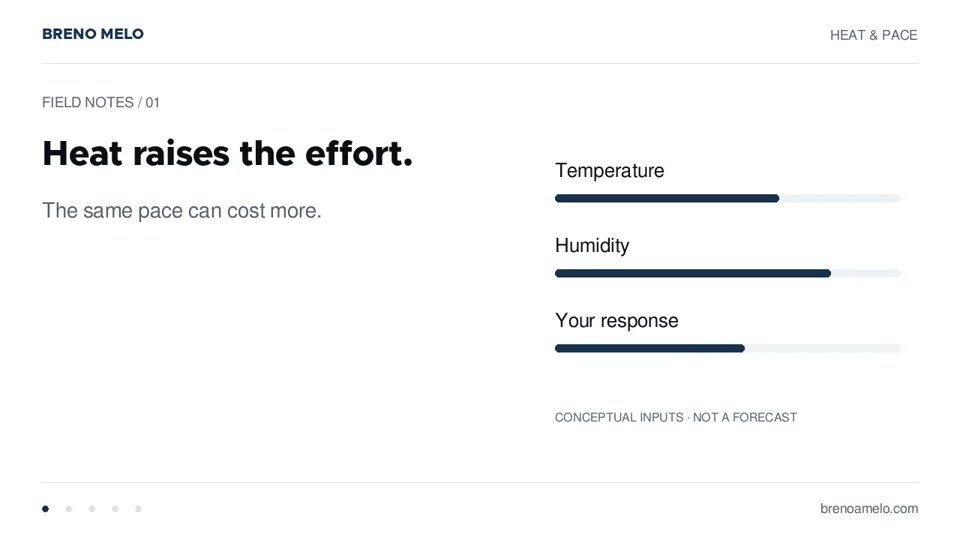
Calculator methods and limitationsHeat raises the effort at the same pace. Enter temperature and humidity to estimate an adjustment. Treat the result as a starting range, not an exact prescription. Acclimation, sun, and your own response matter. Slow down when the effort climbs.
 Watch the field note Close the video
A tool from Breno Melo Endurance Coaching. Meet the coach.
Scenario penalty = 0.0035 × max(0, temperature °C − 12) + 0.0015 × max(0, dew point °C − 16) + 0.000012 × max(0, altitude m − 600). Range uses 0.5–1.5 times the penalty. Heuristic, not a fitted research equation.
Use Fahrenheit or Celsius and enter the humidity expected during the session.
Compare the original pace with the displayed range. This is an explicit sensitivity scenario; breathing, symptoms and conditions take priority over a calculated target.
Public inputs are encoded in share links. Check what you are sharing.
Enter your usual running pace, temperature and relative humidity to compare a heat-adjusted pace range per mile or kilometer. Use Fahrenheit or Celsius; the calculator estimates dew point from your weather inputs and can include altitude. This is a planning scenario, not a prediction of your individual response or an exercise-safety assessment.
Enter a representative pace from cooler conditions, the air temperature and relative humidity. The calculator estimates dew point and applies the displayed heuristic to show a pace range. The range describes the model assumptions, not a guaranteed race result.
Yes. US units use Fahrenheit and pace per mile; metric uses Celsius and pace per kilometer. Switching units converts your inputs so you can compare the same scenario.
Relative humidity is a percentage that depends on air temperature. Dew point is a temperature describing atmospheric moisture. This calculator derives dew point from temperature and relative humidity; do not enter a dew-point temperature into the humidity percentage field.
No. It is a sensitivity range around declared heuristic coefficients, not a statistical confidence interval.
No. Pace adjustments do not assess exercise safety. Dew point and air temperature alone do not describe every source of heat stress.
Scenario penalty = 0.0035 × max(0, temperature °C − 12) + 0.0015 × max(0, dew point °C − 16) + 0.000012 × max(0, altitude m − 600). Range uses 0.5–1.5 times the penalty. Heuristic, not a fitted research equation.
Arithmetic conversions are exact within input precision. Physiology models and planning scenarios are estimates; use the assumptions and your training response.
Yes. Unit preference is remembered on this device. The share link includes calculator inputs; review them before sharing.
No. Results, methodology and printable output are available without an email wall.
UNDERSTAND THE RESULT
Use these guides to understand the assumptions and apply the result to your training.
Start with your usual pace in mild conditions for the same kind of session. Enter the temperature and humidity expected during the run, not the day’s maximum from a different hour. Leave altitude at zero to isolate the heat and humidity scenario.
Relative humidity describes how close the air is to saturation at that temperature. Dew point describes moisture content. This tool computes dew point from the two weather inputs; it does not treat 80% humidity on a cold morning as equivalent to 80% on a hot afternoon.
This tool uses the declared heuristic below, with a sensitivity range. Other tools fit marathon observations or use different temperature thresholds. The range is not a confidence interval, and more decimal places would not make it a personal physiological measurement.
Do not use the range to decide whether conditions are safe or to force a workout pace. Acclimatization, sun, wind, duration and your response remain outside the calculation. Measure sweat rate separately and keep sodium concentration separate from fluid loss.
