
AI bike fit analyzer.
Live, browser-based pose detection. Stand the camera side-on to your trainer, hit Start, and watch knee / hip / back / ankle / arm / torso angles update in real time. Video never leaves your device.
Loading the analyzer…
The pose analyzer runs entirely in your browser. Allow camera access when prompted — no video is uploaded.
Set-up tips
- • Set camera side-on to your bike — same side as the leg you want measured.
- • Get the full body in frame from helmet to shoe.
- • Even, bright lighting in front of you, not behind.
- • Wear form-fitting kit — baggy clothes hide landmarks.
- • Pedal at steady cadence 70–80 rpm. Read knee angle at the bottom of the pedal stroke.
Common questions
How does the AI bike-fit analyzer work?
We run Google's MediaPipe Pose model in your browser to detect 33 body landmarks in real time from your webcam. From those, we compute the six angles that matter for cycling: knee, hip, back, ankle, arm, and torso.
What angles should I aim for?
Road riders: knee 140–150° at bottom dead centre, hip 85–100°, back 35–45°, arm 85–110°, torso 70–90°, ankle 80–100°. Out-of-range readings are flagged in amber.
Can I measure angles manually?
Yes. Toggle Draw Mode and tap three points on the freeze-frame to measure any angle without the AI.
What do I need?
A laptop or phone with a camera and a trainer or rollers. Position the camera side-on, full body in frame, with even lighting. Wear form-fitting kit so landmarks are easy to detect.
How accurate is it?
MediaPipe Pose is research-grade and very stable when you're well-lit and centered. It's not a replacement for a professional fitter for major saddle/cleat changes, but it's perfect for tracking changes over time.
Where is my data stored?
Saved measurements live only in your browser's localStorage. Nothing leaves your device — the model itself runs locally too.
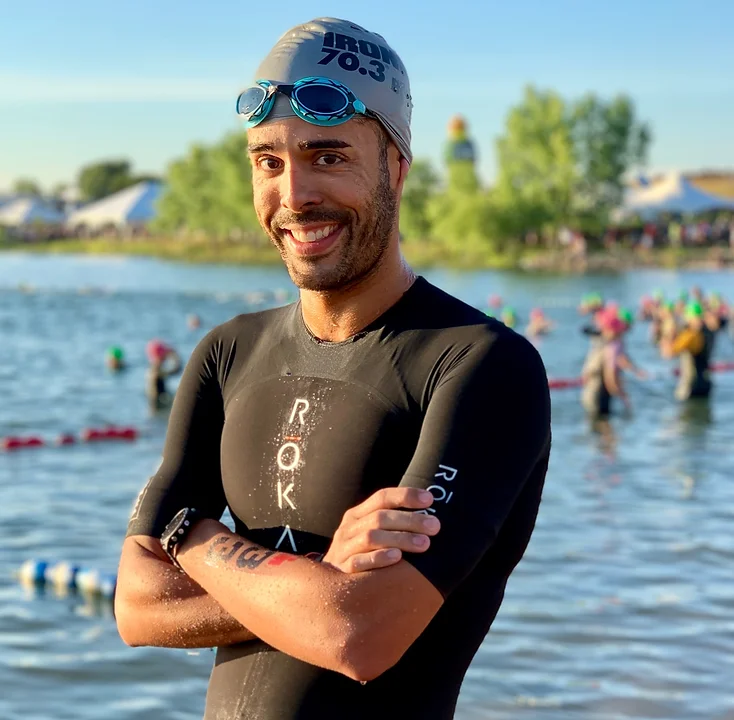 Breno MeloHead Coach · USA Triathlon, Road Runners Club of America, TrainingPeaks
Email me my fit report
Your measured joint angles against the benchmark ranges, with the adjustment order, on one printable page.
No spam. Unsubscribe anytime. We never sell your email.
Inseam-derived starting fit with a knee-angle sanity check
Saddle height ≈ inseam × 0.883 (crank centre to saddle top, LeMond method).
Cross-checked against a 25–35° knee flexion at the bottom of the pedal stroke.
- Inseam was measured barefoot against a wall with a book pulled firmly into the crotch.
- You ride in standard road cycling shoes with cleats set mid-foot-to-ball.
- This is a starting position, not a fit. Femur-to-tibia ratio, hip mobility and flexibility change the right answer.
- It does not address saddle fore-aft, reach, stack, cleat rotation or a time-trial position.
- Anyone with existing knee, hip or back pain should see a professional fitter or clinician rather than use this.
Knee-angle range from cycling overuse-injury literature and saddle-height reviews in trained cyclists; the inseam multiplier is a long-standing practitioner method, not a validated equation.
Formula, constants and cited sources last verified on . Spotted something wrong? Email breno@brenoamelo.com and it gets corrected and dated.
How the angles are measured
MediaPipe pose detection locates body landmarks in each webcam frame, entirely in your browser — no video is uploaded.
Each joint angle is the angle between the two segment vectors that meet at it, sampled across the pedal stroke and reported at the relevant crank position.
Benchmarks: knee extension 140-150° at bottom dead centre, hip angle 45-55°, back angle 40-55° for road, elbow 150-165°.
References
Every physiological claim on this page traces to one of the primary sources below — the original paper, textbook or governing-body standard, not a secondary write-up.
- 01Holmes JC, Pruitt AL, Whalen NJ (1994). Lower extremity overuse in bicycling. Clinics in Sports Medicine 13(1):187–205. PMID 8149382
- 02Bini R, Hume PA, Croft JL (2011). Effects of bicycle saddle height on knee injury risk and cycling performance. Sports Medicine 41(6):463–476. doi:10.2165/11588740-000000000-00000
Using this page in your own work?
Copy a formatted reference below. If you are quoting a number from this page, please link back to it so readers can check the source and the date it was last reviewed.
Breno Melo, "AI Bike Fit Analyzer — Breno Melo Endurance Coaching", Breno Melo Endurance Coaching (last reviewed 18 May 2026). https://www.brenoamelo.com/calculators/bike-fit
FTP Explained for Cyclists
What FTP is, how to test it properly, and how often to retest.
Strength Training for Endurance Athletes
Two sessions a week that protect your durability.
Fueling the Long Ride
Bottle-by-bottle fueling for four hours and up.
Heart Rate vs Power vs Pace
Which metric should anchor your training, and how to combine them.
The fit holds the position. Apex builds the engine.
A good position only pays off if you are training in it. Apex writes the cycling block — sweet spot, threshold, long rides — around the hours you have.
- A structured cycling block from your current fitness
- Sessions that adapt around travel, weather and fatigue
- In-app coach messaging when something feels off
$4.99/month or $49.99/year. 14 days of everything, free, no card. After that your plan and history stay readable; subscribe to keep it adapting. Cancel in one click.
Bike fit is one piece. The plan is the rest.
Get a structured bike build that turns your new position into watts. 1:1 coaching from a TrainingPeaks Level 2 coach.
Boston-based · Trilingual EN/PT/ES · RRCA · USAT · TrainingPeaks L2 · 12× Boston qualifier